Ingenuity Makes Mars Flight A Robotics Problem
NASA's Ingenuity first flight turns powered flight on Mars into a robotics, autonomy, communications, and systems-engineering milestone on another world.
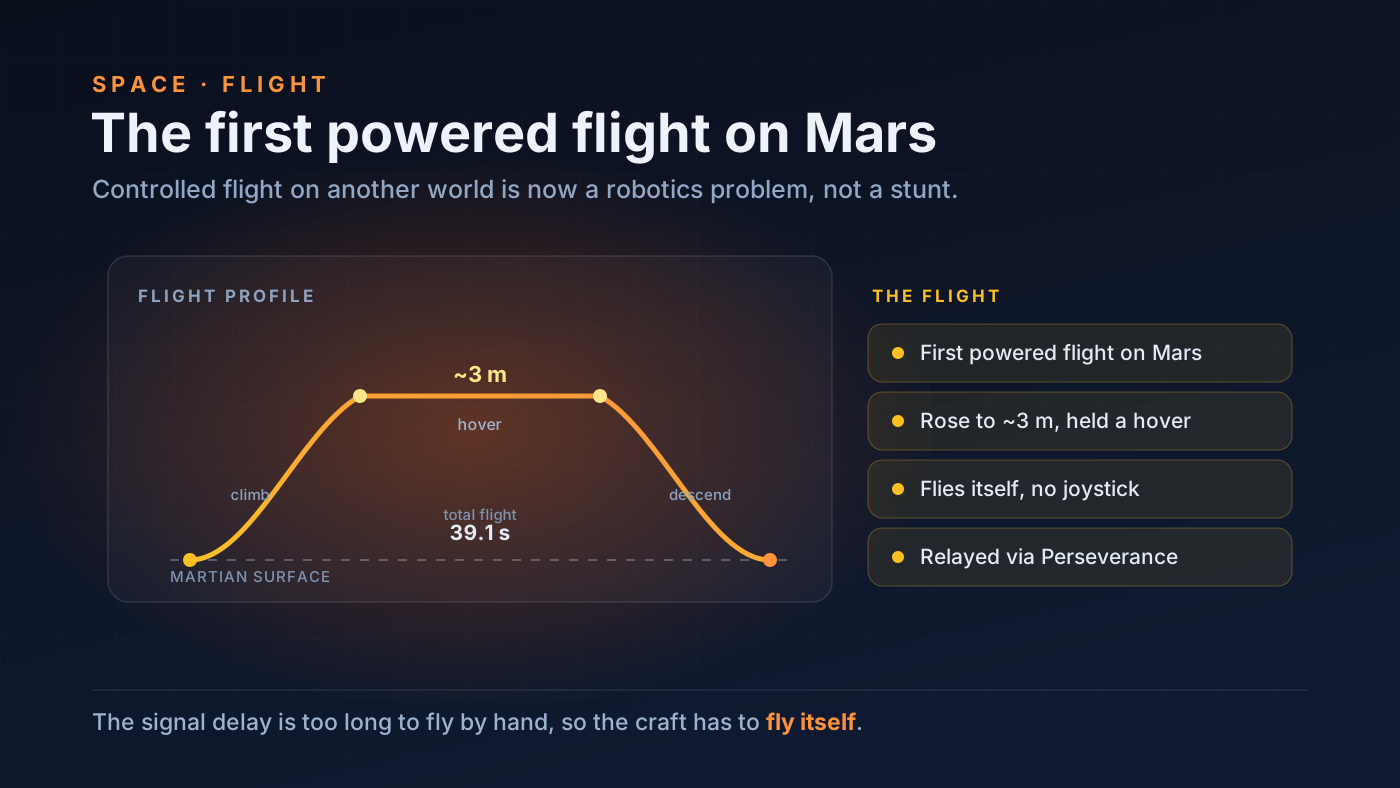
NASA’s Ingenuity helicopter has made the first powered, controlled flight on another planet. The flight lasted 39.1 seconds. It rose to about 3 meters, held a hover, and came back down to the Martian surface.
That sounds small until you add the setting. Mars has less gravity than Earth. But the air is very thin. So Ingenuity must lift off with almost no air to push against.
It also has to live through cold nights and charge from a small solar panel. And it has to fly itself. You cannot steer it by joystick from Earth.
So this flight is part flying and part robotics. It works under delay, doubt, and a hard limit on mass.
 The first flight runs as a small stack. It holds stored commands, onboard sensing, and rotor control. Then it sends a delayed all-clear through Perseverance.
Why April 19 matters
JPL confirmed the flight from data sent through the Perseverance rover. The helicopter lifted off at 3:34 a.m. EDT. The team got word at 6:46 a.m. EDT.
That delay shapes the whole system. Ingenuity cannot wait for a human to fix things in the moment. It has to run the flight on its own. It has to track its own motion, hold itself steady, and then report back.
The first flight is a tech demo. It does not carry science tools. It proves one thing: a craft can fly with control on Mars.
The flight stack
Ingenuity is small, but the control task is hard. It needs fast rotors to fly in thin air. Sensors keep it steady. Onboard compute closes its control loops. And careful power use lets it fly again.
flowchart LR
    A["Commands from Earth"] --> B["Perseverance relay"]
    B --> C["Stored flight plan"]
    C --> D["Onboard guidance and control"]
    D --> E["Rotor and attitude response"]
    E --> F["Nav camera and altimeter feedback"]
    F --> D
    E --> G["Delayed telemetry downlink"]
The loop that counts during flight is local. Earth sends the plan. Mars hardware runs it.
Why thin air changes the design
NASA notes that Mars has about 1% of Earth’s surface air pressure. That makes lift hard to get. So Ingenuity’s rotors are large for its body and spin fast. The craft has to be light, stiff, and easy on power.
The helicopter is also one part of a bigger mission. Perseverance passes its signals along and films the flight with its cameras. The rover sits right in the data path. It helps turn a Mars hover into a proven result.
Think of the mission as one big system with many parts. A small flier, a rover, orbiters, and the team on Earth all work together. They do it across delay and tight limits on bandwidth.
What this opens
The next test flights may push the limits further. If they do, flying scouts could become a real tool for space work. Rovers are great at surface science. But they move slowly and have to dodge rough ground. A flier can scout a route, look at cliffs or crater walls, and reach views that wheels cannot.
Controlled flight on Mars has moved out of the lab and into the real world. That builds plain trust in the design.
Limits and open questions
Ingenuity is still a test. It carries no science tools. It has a short test window. And it has to live through cold nights and many takeoffs. A real work aircraft would need to fly longer, fly itself more, and earn the extra mass with a clear job.
Still, the flight teaches one rule. The signal delay is too long to fly by hand. So the craft has to fly itself this far from Earth.
Mars flight is now a robotics problem. And we can test it against real flight data.