DART Turns Planetary Defense Into A Measured Control Problem
NASA's DART impact tests asteroid deflection as an engineering loop: autonomous targeting, kinetic impact, observation, and orbit measurement.
NASA’s DART spacecraft has hit Dimorphos on purpose. Dimorphos is the small moonlet that orbits the asteroid Didymos. This is the first full-scale test of planetary defense by kinetic impact.
The value is measurement. Can a spacecraft hit a small body at high speed on its own? And can we then measure the change to its orbit? A good measure would help us build better models for the future.
DART asks a clean question. How do you change the path of an object that is millions of miles away? You can not steer it by hand. The last part of the run has to fly itself.
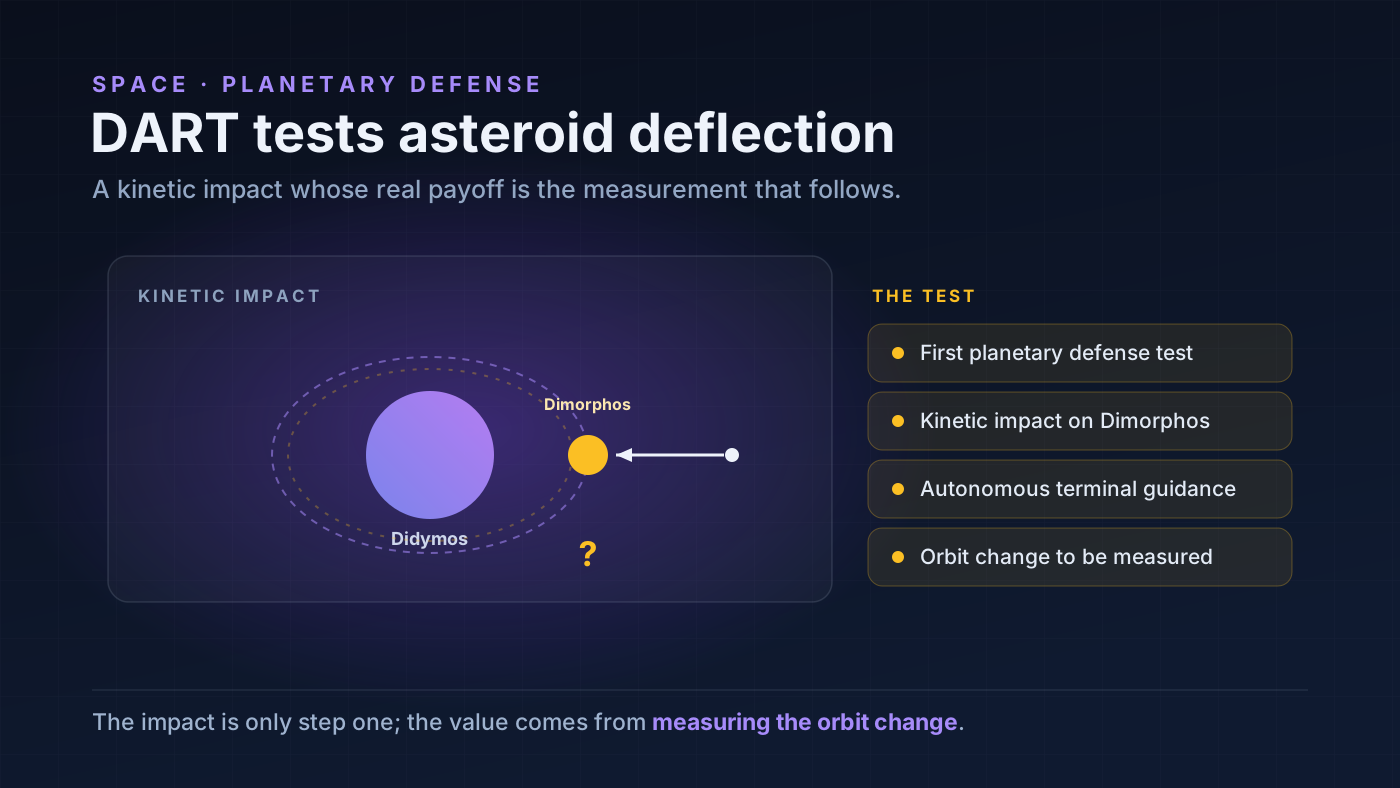 DART is an impact test. The value comes from the whole loop: target, strike, watch, and update the model.
Why September 26 matters
Today is impact day. NASA reports that DART hit Dimorphos. This is the agency’s first planetary defense test. The DRACO camera sent back images as the craft drew near. In the last phase, the craft had to tell the target moonlet apart from Didymos on its own.
You move a body by hitting it. The hard part is making the hit useful.
DART tests one thing. Can a planned hit change a moonlet’s orbit in a way we can predict?
The experiment design
Dimorphos is a good target because it orbits Didymos. That pair acts like a clock we can read. Say DART shifts the orbit of Dimorphos around Didymos. Telescopes would then see the change as a shift in timing.
flowchart LR
    A["Launch and cruise"] --> B["Target acquisition"]
    B --> C["Autonomous terminal guidance"]
    C --> D["Kinetic impact"]
    D --> E["Ejecta and momentum transfer"]
    E --> F["Ground and space observation"]
    F --> G["Orbit-change estimate"]
This setup matters because planetary defense runs on lead time. A small push applied early grows into a big shift later. But planners need real numbers. How much push does the hit pass on? How much do the thrown bits add? And how do the rocks that make up the body change the result?
Autonomy at the edge
DART’s final run is a problem of self-control. Signals take time to cross space, so no person can fly it live. The craft has to read its camera, find the target, and steer into Dimorphos.
This is a common pattern in space robots. People set the goals and the limits. Onboard software flies the loop when distance or timing rules out direct control.
The hit also makes good code very concrete. The guidance system does not get a second try. Steering, imaging, thrust, timing, and fault response all come down to one moment.
What engineers should notice
The best part of DART is how little of it sits in one box.
The camera gives target data, and the autonomy turns those pixels into steering. The thrusters make the fixes, and the hit passes on the push. Telescopes and other tools then judge the result. Those numbers turn the test flight into real planetary-defense knowledge.
That makes DART a systems story. The craft is meant to be thrown away. The thing it builds is the measurement.
Limits and open questions
The hit is only the first measurement. Follow-up observation must estimate the orbital change. Asteroids also vary a lot. Shape, spin, surface, and inner structure all change how a hit moves a body. How loose or packed the rock is matters too.
Planetary defense will never be one tool. It needs ways to spot a threat, to plot its path, to plan a mission, to launch, to model the hit, and to work across borders. DART tests one link in that chain.
Today that link moved from paper to flight hardware.