The First Black Hole Image Is A Computational Instrument
The Event Horizon Telescope's M87 image shows how global radio arrays, timing, correlation, and imaging algorithms become one scientific instrument.
The first image of a black hole is the output of an instrument the size of a planet. That fact shapes how to read it.
The Event Horizon Telescope team has released the first direct visual evidence of a black hole and its shadow. The target sits at the heart of M87, a galaxy in the Virgo cluster. The picture is striking: a bright, uneven ring around a dark core. The engineering story matters just as much. Eight radio dishes, atomic clocks, petabytes of data, signal matching, careful tuning, and separate imaging runs all had to agree.
That makes this a milestone in physics and in measurement at global scale.
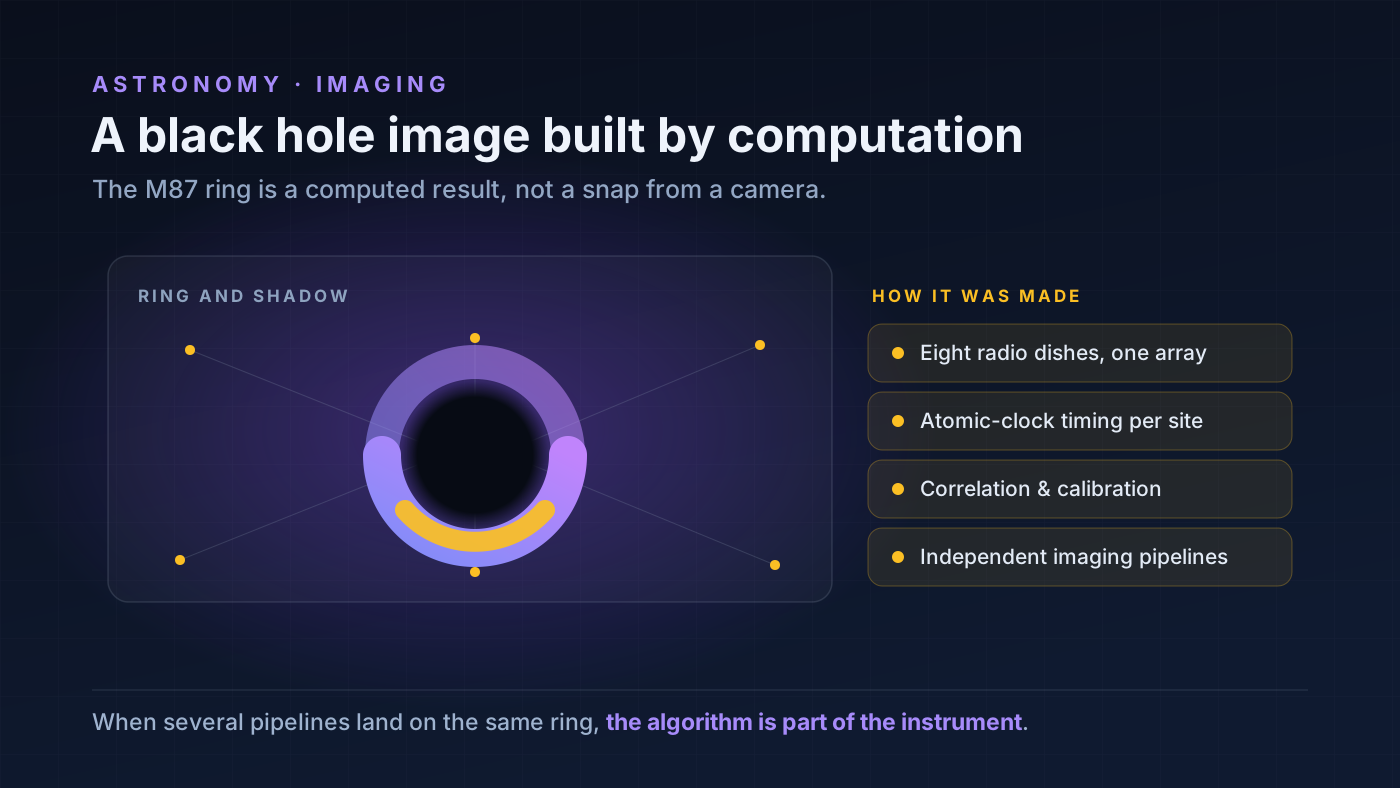 The EHT links dishes around the world into one Earth-sized telescope, then turns the matched data into an image.
Why this image is different
No camera takes a picture of a black hole with bounced light. The image shows glow from hot gas near the hole, bent by strong gravity into a ring around a shadow.
M87 is a good target. Its central black hole is huge, roughly 6.5 billion times the mass of the Sun. It is also close, on cosmic scales. That lets an array with very long baselines pick out its shadow. The EHT observes at 1.3 millimeters. It uses telescopes spread across Earth to act as one much larger dish.
The key idea is aperture synthesis. One pair of telescopes captures part of the fine detail of the source. Many pairs, watching as Earth turns, fill in enough detail to rebuild a solid image.
flowchart LR
    A["Radio observatories"] --> B["Atomic-clock timing"]
    B --> C["Recorded millimeter-wave data"]
    C --> D["Correlation"]
    D --> E["Calibration"]
    E --> F["Independent imaging pipelines"]
    F --> G["Ring and shadow reconstruction"]
So the final image is a computed result, not a snap from a camera.
The engineering stack
The ESO release calls the EHT a planet-scale array of eight ground-based radio dishes. The sites are harsh and high: Hawaii, Mexico, Arizona, Spain, Chile, and Antarctica.
Wide spacing is what gives the array its sharpness. The cost is how hard the array is to run:
- Each site needs precise timing from atomic clocks.
- Weather has to be good at all the sites at once.
- Each telescope records huge volumes of data.
- Hard drives have to be flown to central sites for matching.
- The team must correct for the gear, the air, and sparse coverage.
- Imaging code must rebuild structure from partial data.
The team reports that several distinct tuning and imaging methods all produced a ring with a dark center. For an object this hard to see, confidence comes from separate paths landing in the same place.
Why the ring matters
General relativity makes a clear prediction. A black hole sitting in bright glow should cast a shadow. Light paths curve around the dense object. Some photons escape, some orbit, and some fall in. The result should be a dark core with glow around it.
The M87 image gives a new handle on that regime. Past tests of the theory have been strong, but this one sits near the scale of an event horizon. It lets scientists check the measured ring against models of warped spacetime and hot gas.
The brighter lower part of the ring also means something. It reflects uneven glow in the gas and the effects of motion near light speed close to the hole.
The image is best read as a measured structure with error bars. The separate pipelines agree most clearly on the ring.
Why computing belongs in the story
None of this works without code at every step.
The raw data is too big to send over normal networks, so hard drives travel by plane. Correlation lines up signals from dishes thousands of kilometers apart. Imaging then turns sparse samples into a picture while it guards against false detail.
A sparse array can invent structure if the rebuild step is sloppy. That is why the team used several imaging methods and tests on synthetic data. Those checks are central to the claim.
There is a broader lesson here for science: the algorithm is part of the instrument. It must be tested like hardware.
Open questions
The image opens more work than it closes.
Several questions are live right now:
- How stable is the ring over time?
- What does the uneven brightness say about spin, plasma, and viewing angle?
- How does the black hole connect to M87’s large jet?
- Can the same methods image Sagittarius A*, the compact object at the center of the Milky Way?
- Which added telescopes or wavelengths would sharpen the picture?
So the first image is a starting point for science at the event-horizon scale.
Takeaway
The M87 image is a physics result and an engineering result at once. Synced dishes, sharp timing, heavy data work, and careful imaging code acted as one. Together they picked out structure at the edge of a black hole.
That is the lasting lesson from today. Sometimes the instrument is a whole system rather than one machine, run so tightly that Earth itself becomes part of it.
References
- European Southern Observatory, “Astronomers Capture First Image of a Black Hole”, April 10, 2019.
- Event Horizon Telescope Collaboration, “First M87 Event Horizon Telescope Results. I. The Shadow of the Supermassive Black Hole”, The Astrophysical Journal Letters, April 10, 2019.
- Event Horizon Telescope Collaboration, “First M87 Event Horizon Telescope Results. IV. Imaging the Central Supermassive Black Hole”, The Astrophysical Journal Letters, April 10, 2019.