Sycamore Turns Quantum Advantage Into A Systems Benchmark
Google's Sycamore result frames quantum advantage as a systems benchmark built from qubits, gates, error rates, sampling, and verification data.

Google’s Sycamore paper in Nature reads like one headline about speed. There is a better way to read it. Quantum computing now has a real systems benchmark out in the open.
The chip is a programmable superconducting processor with 53 working qubits. It samples from random quantum circuits. The paper says Sycamore ran the target sampling task in about 200 seconds. The authors estimate the same task by classical means would take far longer on a leading supercomputer. The result is narrow on purpose. It is one quantum sampler making a spread of outcomes that is hard to copy on a normal computer.
That makes the benchmark more interesting, not less. It hands engineers something they can measure: qubit count, gate fidelity, circuit depth, sampling rate, calibration, classical checking, and how errors behave.
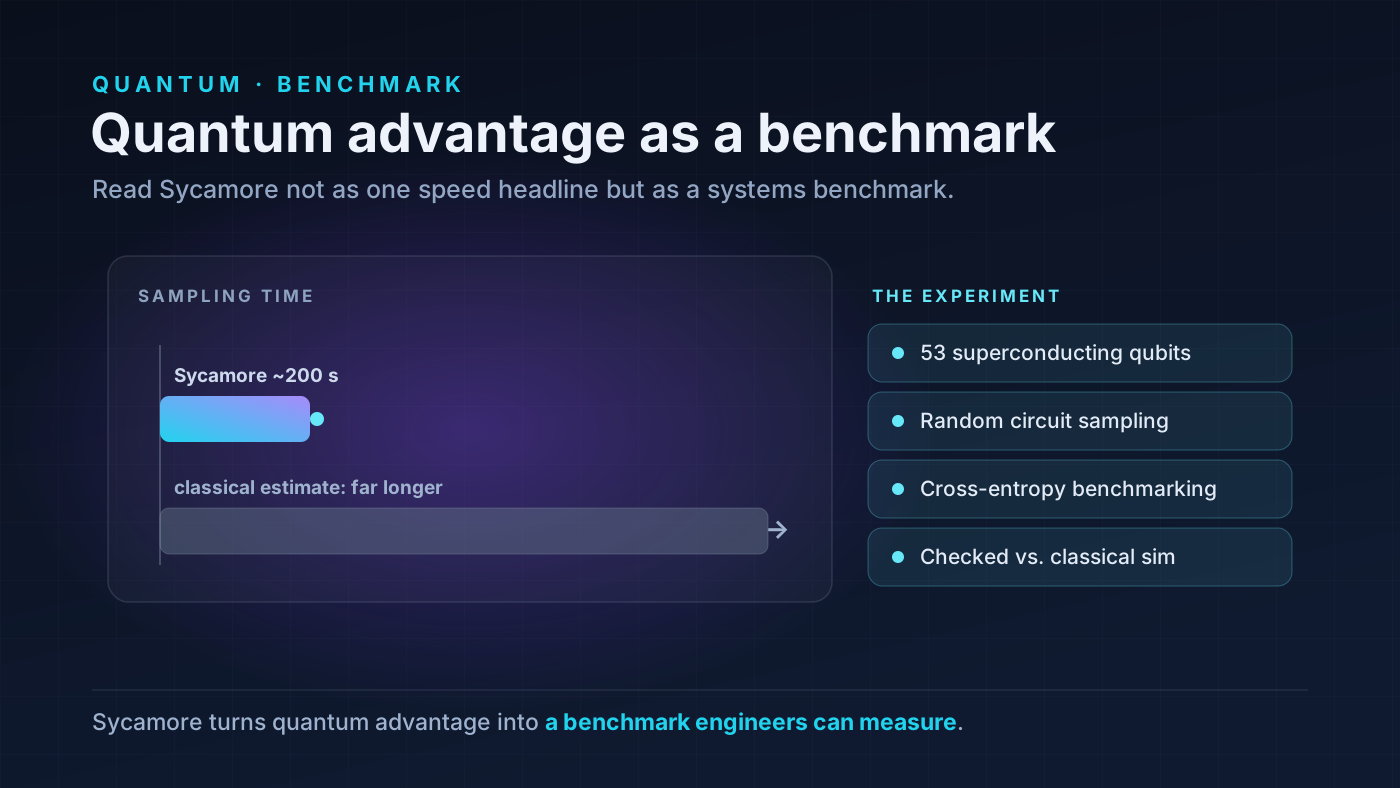 The milestone is a stack you can run again: build a circuit, sample it, then check it.
Why October 23 matters
Today the Sycamore result appears in Nature. The date matters because the paper shows both the claim and the way the team checked it.
The system builds random quantum circuits. It samples bitstrings from the spread of outcomes. Then it checks smaller or simpler circuits against classical simulation. That last step is the key one. A quantum device is not useful if it spits out data that nobody can verify. It earns trust when a team can tie the hardware behavior to a model, then say where direct checking runs out.
This is a benchmark for near-term quantum hardware. It is not a claim that error-corrected quantum apps are ready.
The engineering shape of the result
The phrase “quantum supremacy” makes the work sound like one line being crossed. The real thing looks more like a stack.
At the bottom is the superconducting hardware. Qubits have to be built, cooled, controlled, coupled, and measured. On top of that sit microwave control pulses and gate schedules. The top of the stack builds circuits, samples them, and compares the numbers against classical simulations.
flowchart LR
    A["Fabricated qubit array"] --> B["Calibration and gate control"]
    B --> C["Random circuit execution"]
    C --> D["Bitstring samples"]
    D --> E["Cross-entropy benchmarking"]
    E --> F["Classical simulation boundary"]
Each layer can fail in its own way. A qubit can lose its state. A gate can leak error into the next step. Readout can skew the sample. Classical checking can grow too costly. The paper is worth reading because it treats the benchmark as one measurement problem from end to end, not as a black box.
Why random circuits are useful
Random circuit sampling is a stress test for a quantum processor. It is not a business app.
A good near-term benchmark has to do two things at once. It has to be hard enough to push real quantum behavior. It also has to stay checkable while the circuits are still small enough for classical methods to reach. Random circuits turn simple steps into a messy spread of outcomes. As the depth and qubit count grow, exact classical simulation gets costly fast, because the number of states it must track grows so quickly.
The experiment tests one thing. It asks whether the hardware is reaching a point where brute-force classical tracking stops being routine.
What engineers should watch
The near-term questions are ones you can measure:
- Can gate fidelity improve while qubit count rises?
- Can calibration stay stable enough for deeper circuits?
- Can checking methods keep pace with larger processors?
- Can near-term hardware move from toy sampling tasks toward chemistry, materials, optimization, or simulation workloads?
The result also brings a messaging problem. A benchmark that beats a classical estimate on one task is easy to oversell as a product. The honest take is smaller and firmer. It is a sign that the hardware, the control systems, and the checking math can now put out a public result that earns hard technical review.
Open questions
Sycamore does not end the need for error correction. The processor is noisy. The benchmark is narrow. Other teams will probe the classical comparison and sharpen it. None of that makes the milestone empty.
For software engineers, here is the shift that counts. Quantum computing used to be mostly theory waiting on hardware. It is turning into a full-stack craft. Hardware limits, compiler choices, calibration loops, and benchmark rules all shape the claim.
That is a much better problem to have.